
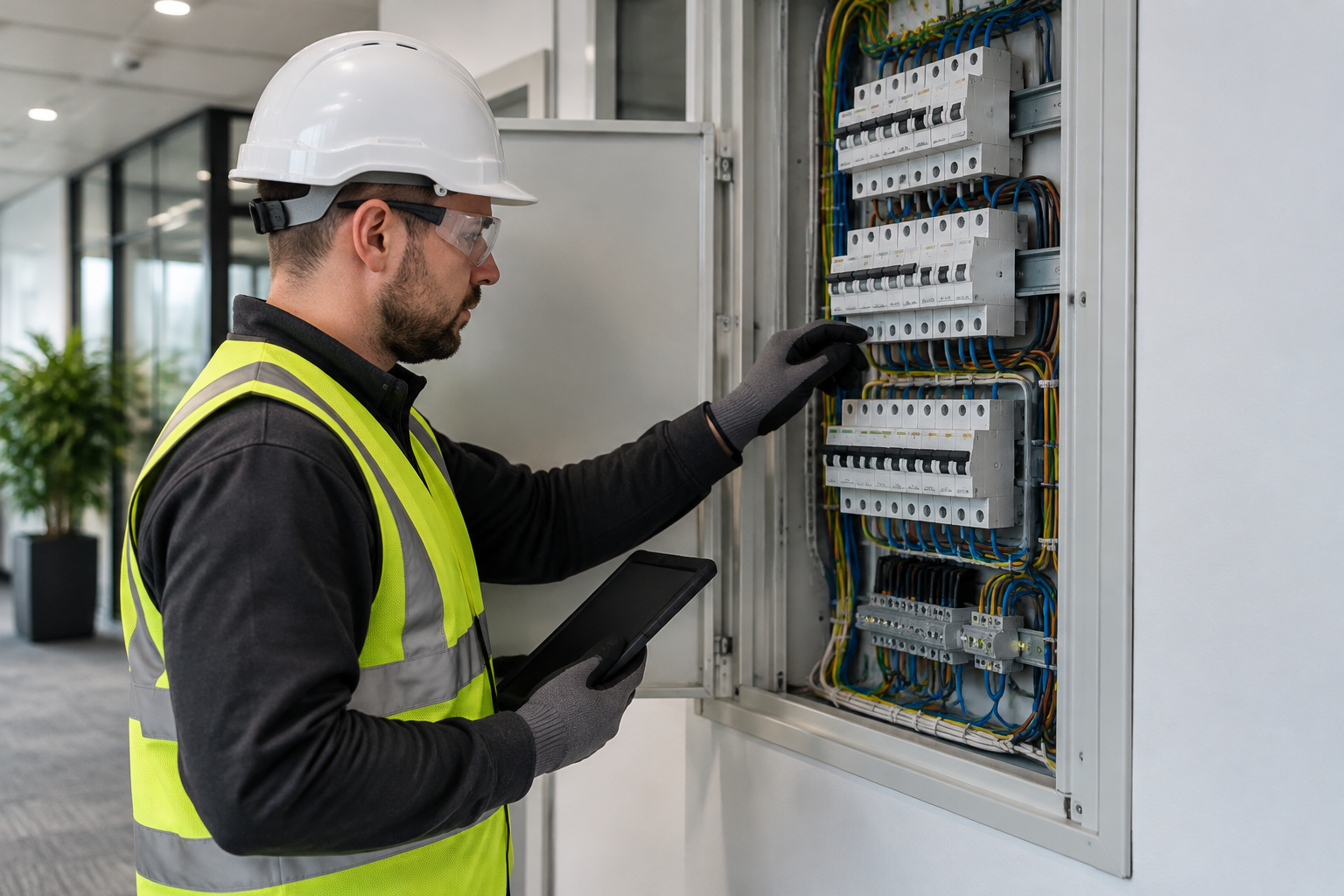
Managing business premises in South Yorkshire means balancing productivity, security, and statutory compliance. For business owners, facilities managers, and commercial landlords in Barnsley, ensuring your electrical systems are safe and properly maintained is a fundamental responsibility. When arranging testing, understanding the correct legal scope, how inspections work, and what preparations are required can save time, minimise downtime, and protect your staff, customers, and property.
At Redbrook Electrical Service LTD, our local team brings over 20 years of electrical-industry experience to commercial and industrial sites across Barnsley and the surrounding areas. In this guide, we break down what you need to know about commercial electrical inspection Barnsley requirements, how to prepare your premises, and what to expect from the testing process.
Is an Electrical Inspection Legally Required for Commercial Premises in Barnsley?
Direct Answer: Yes, employers and dutyholders have a clear legal duty to keep electrical systems safe, but UK workplace regulations do not prescribe one universal, fixed-schedule Electrical Installation Condition Report (EICR) interval for all commercial properties. Instead, under the Electricity at Work Regulations 1989 (Regulation 4), electrical systems must be constructed, maintained, and kept in a safe state to prevent danger, so far as reasonably practicable.
How you fulfill this duty depends entirely on your specific system, operating environment, risk profile, and type of use. While a periodic inspection and test by a competent electrician forms a crucial part of a suitable maintenance regime, you should also review any site-specific obligations:
- Commercial Leases: Many commercial property lease agreements specify particular testing intervals (such as every 3 to 5 years).
- Business Insurance: Insurers frequently stipulate periodic EICRs or specific maintenance schedules as a condition of coverage.
- Licensing Requirements: Certain commercial venues, hospitality businesses, and public spaces require regular inspection reports to maintain local licensing.
- Fire Safety Duties: The Regulatory Reform (Fire Safety) Order 2005 requires appropriate maintenance systems for electrical equipment and devices to safeguard relevant persons.
Note for Residential Landlords: The 5-year fixed EICR rule mandated by the Private Rented Sector (England) Regulations 2020 applies specifically to residential private tenancies and should not be confused with general commercial premises rules.
Fixed Installation Testing vs. PAT Testing: What's the Difference?
Business operators often confuse fixed installation testing (often reported via an EICR) with Portable Appliance Testing (PAT). They are distinct processes designed for different parts of your electrical infrastructure.
| Inspection Type | What It Covers | Primary Purpose |
|---|---|---|
| Fixed Installation Inspection (EICR) | Consumer units, distribution boards, fixed wiring, socket outlets, lighting circuits, and isolators. | To uncover hidden wear, damage, deterioration, or non-compliance in the building's core electrical infrastructure. |
| PAT (Portable Appliance Testing) | Kettles, computers, desk lamps, extension leads, and other appliances with plugs. | To check that moveable electrical equipment is mechanically safe and electrically sound for ongoing use. |
As noted in HSE PAT guidance, the law does not dictate a rigid annual testing schedule for every single appliance; checks must be proportionate to the equipment type and environment.
How to Prepare Your Barnsley Business Premises for an Inspection
Proper preparation ensures that the inspection runs smoothly, minimises disruption to your staff, and allows the electrical contractor to access all necessary areas safely. We recommend taking the following practical steps before your electrician arrives:
- Ensure Clear Access: Clear pathways to distribution boards, electrical cupboards, sub-panels, and fixed equipment. Move boxes, stock, or furniture blocking access.
- Gather Existing Documentation: If available, have previous inspection reports, circuit charts, and details of recent electrical alterations ready for the technician.
- Plan for Planned Outages: An thorough fixed-installation test requires safely isolating certain circuits or shutting down sections of the power supply. Discuss operational downtime and staging options with your contractor in advance.
- Identify Sensitive Equipment: Inform your electrician about sensitive IT servers, machinery, or business-critical processes that require controlled shut-down procedures.
- Communicate Site Hazards: Let the contractor know about any restricted zones, specific safety inductions, or unique operating conditions on your site.
Understanding Inspection Outcomes and Reports
Once the inspection and testing are complete, you will receive a comprehensive report detailing the condition of the installation. Findings are typically categorised using standard observation codes (such as C1 for danger present, C2 for potentially dangerous, C3 for recommended improvement, and FI for further investigation required), as outlined in IET inspection and testing guidance.
If urgent defects are identified, prompt remedial work will be necessary to ensure safety and compliance. Always clarify with your contractor whether remedial repairs are included in the initial testing quotation or priced separately as a follow-up scope.
Frequently Asked Questions
How often should a commercial EICR be carried out?
There is no single statutory interval for commercial buildings. Frequency is determined by your risk assessment, the nature of your business activities, environmental conditions, lease agreements, and insurance policies. High-risk environments or industrial sites typically require more frequent testing than standard retail units or offices.
Will the electricity need to be switched off during the test?
Yes, dead testing of circuits requires temporary power isolation. However, experienced commercial electricians can often stage the work outside of normal operating hours or section off distribution boards to keep critical parts of your business running.
Is PAT testing included in a fixed installation inspection?
No. Fixed installation testing covers the building's wiring and distribution boards, whereas PAT testing covers portable appliances. They are separate scopes of work, though a comprehensive commercial contractor like Redbrook Electrical Service LTD can easily bundle both services together for your site.
What should I do if my report contains C1 or C2 observations?
A C1 code means danger is present and immediate action is required to eliminate risk. A C2 code indicates a potentially dangerous condition that requires urgent remedial attention. You should arrange for a qualified electrician to rectify these issues as quickly as possible to maintain a safe workplace.
Need professional guidance or a dependable local contractor for your commercial or industrial property in South Yorkshire? Visit our dedicated commercial electrical services page or contact Redbrook Electrical Service LTD to discuss your site requirements today.
